Does tin or copper react with sake?
A lot of places claim that tin and copper both react with sake while using them as chirori during the heating process. Many of these statements includes claims that tin will:
remove “impurities” from sake
remove bitterness or roastiness
mellow sake
Are these claims backed up scientifically? And perhaps more importantly, can people tell the difference between sake that has been in contact with tin and sake that hasn’t?
A Quick Note on Thermal Conductivity
Different materials have different thermal conductivity, i.e. how quickly it will heat the sake while warming. For example, copper’s thermal conductivity is ~401(W/m ⋅ K) while glass is ~1 (W/m ⋅ K). Therefore, copper will heat you sake much faster than glass, which can definitely have an effect on the sake’s taste. You can read more about it in my article here.
This article is not investigating or challenging that claim.
Instead, we’re investigating the idea that the copper or tin reacts with the sake directly through “ionic” or other processes. You could imagine an experiment where you used different temperature water baths and thickness of chiroris to heat sake in glass and copper at the exact same rate. Would those sakes taste the same or different? That’s what we’re trying to figure out.
The Science
Unfortunately, there aren’t any direct studies on the topic. Despite studies on tons of different sake topics, no one has tested this hypothesis in a lab.
However, there are a few different theories as to how tin or copper could react with sake. They include:
An ionic reaction wherein the tin ions react with the amino acids or sulfur in sake to change how they are perceived
A catalyst for natural reactions that would otherwise not occur without tin nanoparticles present
Stabilization by a redox reaction, which would reduce some natural processes like oxidation
All of these theories are based upon the idea that tin or copper nanoparticles or ions leech into the sake through surface contact during heating. In theory, if the copper or tin leeches enough particles into the sake during contact, there are a bunch of reactions they could inhibit or accelerate, changing the flavor perception of the sake.
And yet, there aren’t any studies indicating the amount of leeching that occurs during the heating process. Tin naturally forms a layer of tin oxide, which would form a protective layer both to prevent leeching and increase resistance to the various organic acids in sake.
So, it’s a mixed bag. Hypothetically it could have an effect, but it’s hard to say if there’s enough interaction to matter, and if so, if people can taste the difference.
An Experiment
The Tamagawa shown here was not the sake used in this experiment
Let’s test it out, then.
We performed two experiments to see if people could identify any taste changes in sake due to these effects. In order to do so, we had to be a bit creative in order to control for the thermal conductivity of the materials.
For both of these experiments, we used Rihaku Dance of Discovery Junmai sake. We had 4 participants judging the taste of the sake.
Experiment #1
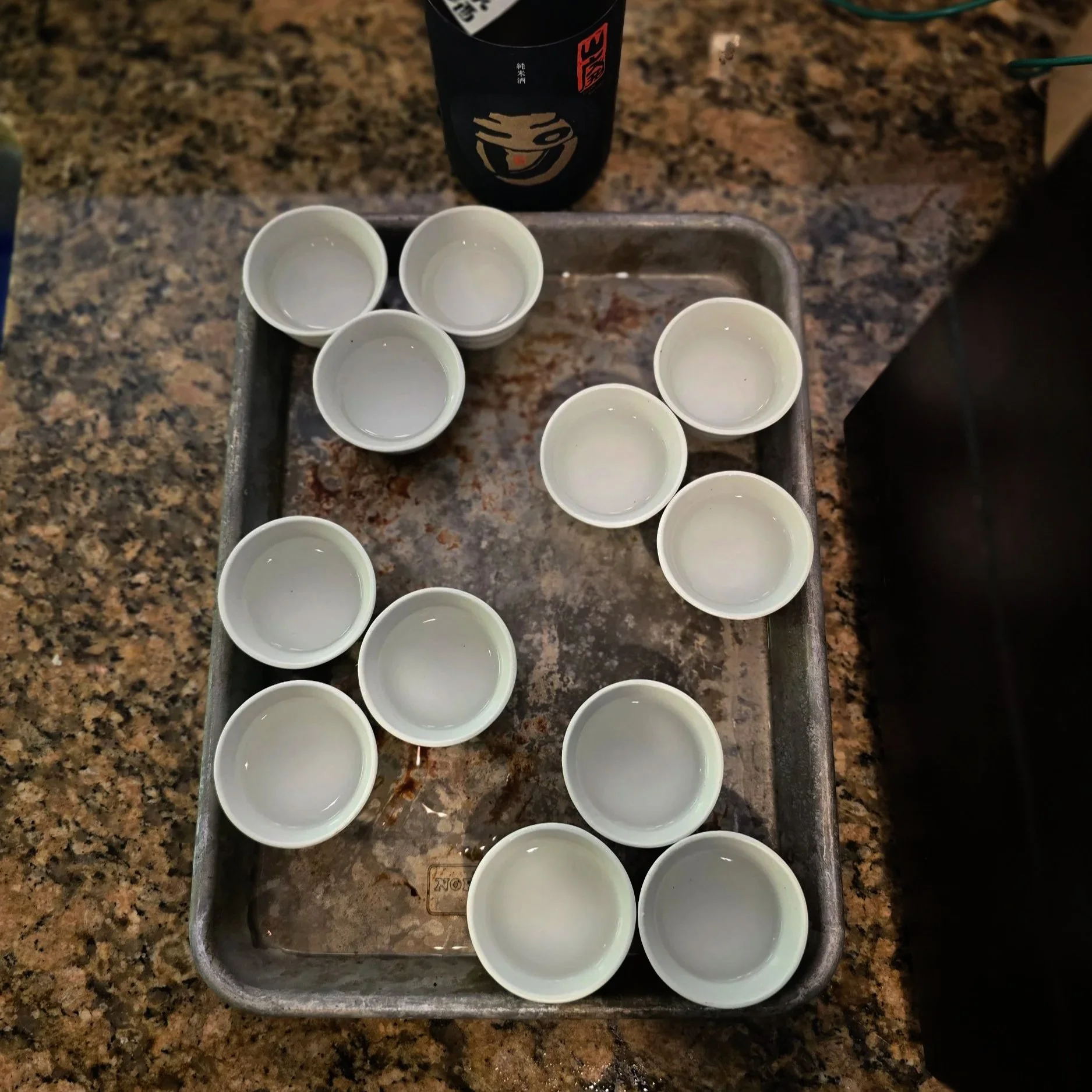
For this experiment, I poured an equal amount of sake into a glass beaker and a tin chirori at room temperature. I let the sake rest in both containers for 2 hours. Then, I poured the sake from the tin chirori into an identical glass beaker and heated both to 60C. I then poured the sake into identical ochoko marked A or B on the bottom. The sake was served to each participant using a triangle test in which they had two glasses of one sake and one of another, and were asked to identify the odd one out.
This experiment was designed to see if the interaction between tin and sake took place at room temperature. I used an extended resting period (2 hours) to make sure that there would be enough time for any reaction to take place. Heating in identical glass beakers ruled out thermal conductivity as a factor
In the end, no participant was able to tell the difference - everyone guessed incorrectly.
Experiment #2
This time, I poured the entire amount of sake into a glass beaker and began to heat it to 60C in a water bath set to 60C. I also let a tin chirori preheat in the water bath to 60C. Once the sake in the breaker reached 60C, I poured half of the sake into the tin chirori and let them both rest for 5 minutes in the water bath at equilibrium. I then followed the identical process described above, asking participants to identify the differing sake in a triangle test.
Compared to experiment #1, this would determine if heat was a necessary condition for any sort of reaction between the tin and sake to occur, while still controlling for the thermal conductivity of each vessel.
Confirming the results from experiment #1, no participant was able to identify the different sake from their triangle test
So what does this all mean…
To be frank, there are many limitations of these experiments. Both involved only 4 participants, serving things completely identically is difficult with a hot beverage that is rapidly cooling, and it was only a single type of sake. It would be hyperbolic to say that this puts the debate to rest and the metal is irrelevant aside from thermal conductivity.
However, considering not a single person guessed correctly (worse than random chance), but also that people admitted they were mostly guessing because they couldn’t tell a difference, there is something to be had here.
We can probably draw a conclusion that for a “typical” bottle of sake, for “typical” consumers, the metal is not having a noticeable effect on the flavor of the sake independent of its thermal conductivity.
Side note, I’ll plan on repeating these experiments with different participants and a different sake to add more data points, specifically with a sake with more amino acids and sulfur to see if there is a noticeable reaction there. But until then, I’m content with the results we have so far.